


Materiality
The LOGISTEED Group Material Issues
The Group identified 15 material issues in FY2017 and developed four Focus Areas from CSV* viewpoint, but we reviewed the material issues in FY2021 in light of drastic changes in issues and management environment relating to sustainability. In doing so, we identified material issues not only from ESG perspective but also in consideration of their relevance to solutions for social issues in the logistics industry and the business strategy. As a result, we identified a total of 12 material issues including those with strong focus on business and those unique to logistics operations, which is a social infrastructure, such as "Prevent accidents during operation" and "Enhance disaster prevention/mitigation."
With the recognition of the identified material issues as the social responsibility that the Group should fulfill, we promote effective activities toward solving social issues.
*Creating Shared Value (CSV): Refers to practices that balance activities to create economic benefits with solutions to social issues, or management strategies to achieve them
Identification process
Step 1: Identified issues
- Understood issues of previous material issues identified in FY2017
- Identified ESG issues (SDGs, evaluation items by ESG rating agencies, disclosure guideline for non-financial information, material issues in the logistics industry, issues in our business strategy, strategic issues of corporate divisions)
- Created a list of material issues
Step 2: Prioritized issues
- Assessed the importance for stakeholders(Assessment weight of each industry by ESG rating agencies, Issues considered important by institutional investors, Investor survey)
- Assessed the importance for the Company(LOGISTEED WAY, our business measures, ESG initiatives, Medium-to-Long-term environmental targets, etc.)
Step 3: Checked the adequacy
- 1.
Assessment by the management
- 1.
Assessment of material issues by the management
- 2.
Discussion at the management workshop based on the assessment result in 1
- 1.
-
2.
Check of the adequacy by external experts
Interview by external experts about the assessment process and adequacy of material issues
-
3.
Check of adequacy and approval by the Board of Directors
Developed Focus Areas and KPIs based on material issues
Material issues
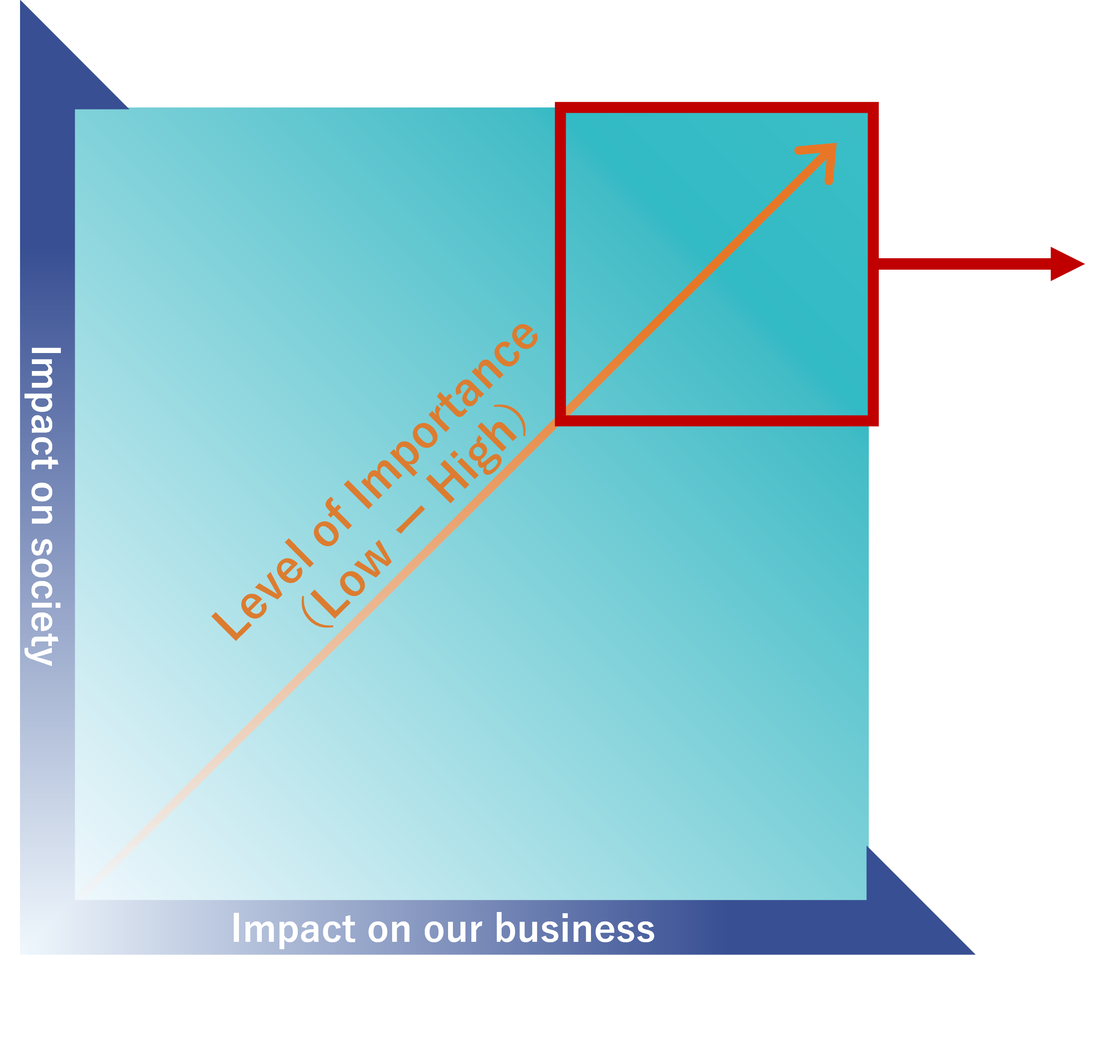
- Contribute to decarbonized society
- Contribute to recycling-oriented society
- Secure diverse human resources to support growth
- Realize safe, healthy and rewarding workplace
- Establish a responsible supply chain in which human rights are respected
- Governance and compliance
- Prevent accidents during operation
- Risk management
- Build and evolve resilient, sustainable logistics services
- Step up DX
- Establish business models through collaborative innovation
- Enhance disaster prevention/mitigation
Check the adequacy of material issues
In the material issues review conducted in FY2021, we carried out dialogue with external experts on identified processes and identified adequacy of material issues.
Development of Focus Areas
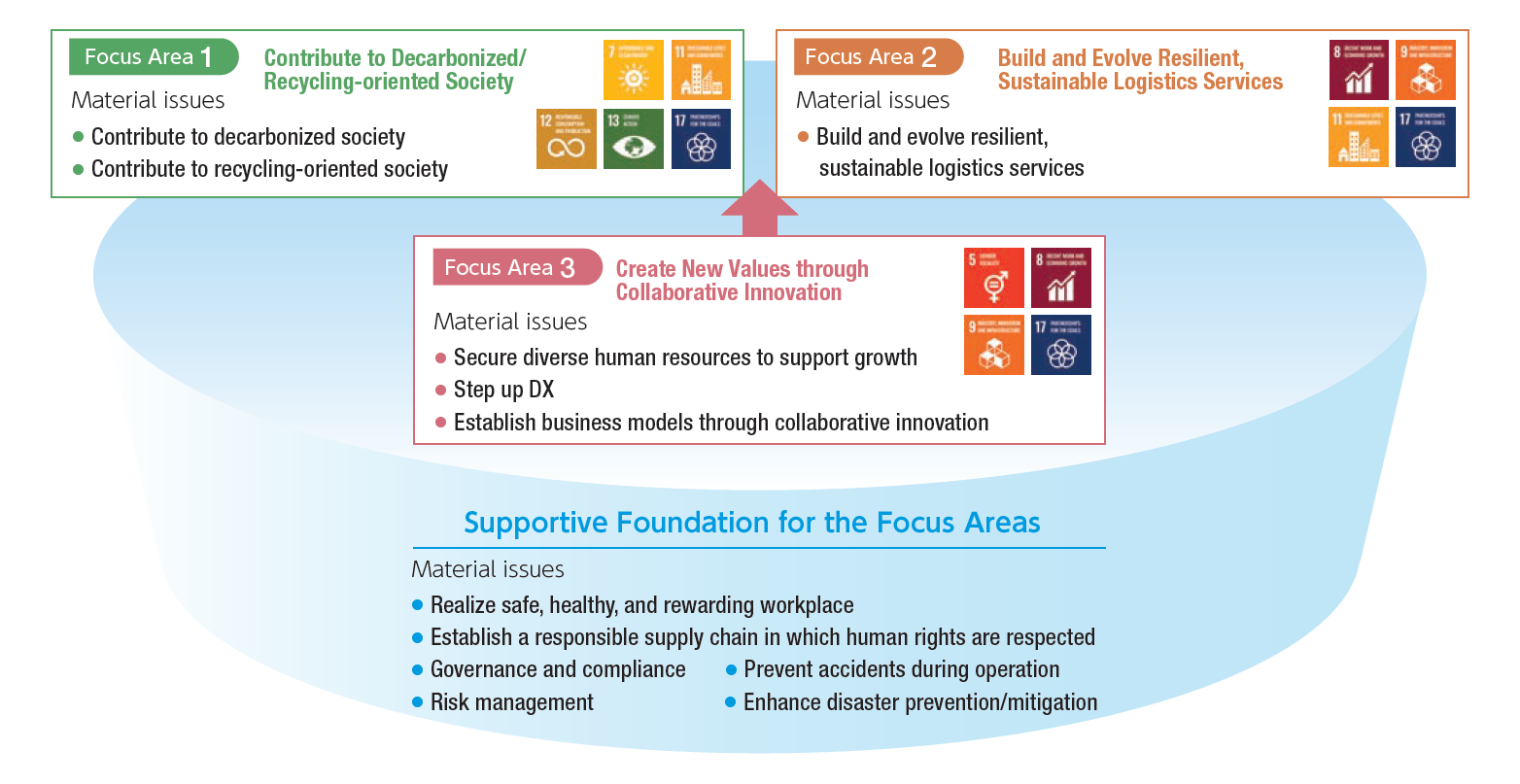
To decide specific activities for the issues that we should address with priority, out of the 12 material issues identified, we classified those related to value creation into three "Focus Areas"; and we classified those related to the business base, such as compliance and risk management, into "Supportive foundation for the Focus Areas." We also clarified the relation between the Focus Areas and SDGs.
The Group is fully aware of the importance of achieving the Sustainable Development Goals (SDGs*), the universal goals the international community is aiming to reach by 2030.
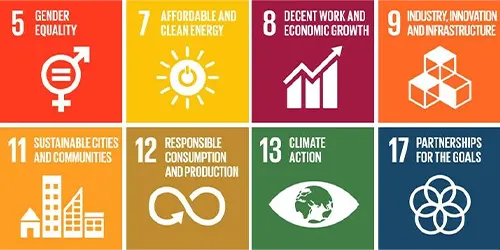
Among the 17 SDGs the following eight goals are especially relevant to our Focus Areas. We will work with various stakeholders to do our part in achieving these SDGs as we move into high gear to reach our goals.
※ SDGs:Sustainable Development Goals
SDGs were unanimously adopted by 193 UN member nations at the UN Sustainable Development Summit held in September 2015. SDGs are essentially a universal call to action, involving both developing as well as developed countries, and a commitment to "leave no one behind."
Focus Area1Contribute to Decarbonized/Recycling-oriented Society
We aim to contribute to a decarbonized, recycling-oriented society by promoting initiatives to reduce greenhouse gas (CO2) emissions, improve the efficiency of energy use, reduce / avoid resource use, and prevent environmental pollution.
Material issues
- Contribute to decarbonized society
- Contribute to recycling-oriented society

Focus Area2Build and Evolve Resilient, Sustainable Logistics Services
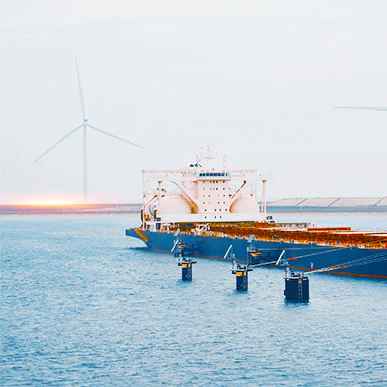
We are working to sophisticate its supply chain optimization services and enhance its warehousing and transport businesses with an aim to build and evolve resilient and sustainable logistics services with a high level of safety/quality/productivity that contribute to solving social issues.
Material issues
- Build and evolve resilient, sustainable logistics services
Focus Area3Create New Values through Collaborative Innovation
We have been promoting DX and collaborative innovation across industries to create new values.
Material issues
- Secure diverse human resources to support growth
- Step up DX
- Establish business models through collaborative innovation


Supportive Foundation for the Focus Areas
We define matters related to our business base, such as safety, enhancement of disaster prevention/mitigation, and respect for human rights, as "Supportive Foundation for the Focus Areas," and take various measures to accelerate initiatives for three Focus Areas.
Material issues
- Realize safe, healthy, and rewarding workplace
- Establish responsible supply chain in which human rights are respected
- Governance and compliance
- Prevent accidents during operation
- Risk management
- Enhance disaster prevention/mitigation
Main initiatives in Supportive Foundation for the Focus Areas(PDF, 73Kbytes) 
KPIs for Material Issues
We have set KPIs for 12 identified material issues based on the priority measures, etc. of the Mid-term Management Plan "LOGISTEED2024." We will promote group-wide initiatives to address issues, manage the progress of KPIs, promote information disclosure, and aim to realize a sustainable society through dialogues with stakeholders.
Integrated Report 2025 (P43-48) Material Issues and KPI (PDF format, 233kBytes)